Rider vs walk-behind floor scrubbers: which should you buy?
Short answer
Choose a rider for a large, open floor you want cleaned in fewer operator hours. Choose a walk-behind for smaller areas, crowded aisles and rooms you clean one at a time. Every FactoryCat rider covers more floor per hour than any FactoryCat walk-behind: up to 18,000 to 29,374 sq ft per hour against up to 7,308 to 15,784 (practical rates, ISSA 2010 cleaning times).
How much floor does a rider clean compared with a walk-behind?
FactoryCat's four current walk-behind scrubbers clean up to 7,308 sq ft per hour (MicroMini), 12,059 (Micro-HD), 13,454 (Mini-HD) and 15,784 (Mag-HD) in practical use, based on ISSA 2010 cleaning times. Its four rider scrubbers clean up to 18,000 (Pilot), 21,661 (GTX), 23,627 (GTR) and 29,374 (XR). So even the smallest rider covers more floor per hour than the largest walk-behind.
A wider path means fewer passes over the same floor. Rider disk paths run from 26 to 45 inches, and walk-behind disk paths from 17 to 34 inches. But width is only part of the gap. The GTX rider and the Mag-HD walk-behind both take a disk deck up to 34 inches wide, and the GTX still covers more per hour. The Pilot's disk path is narrower than the Mag-HD's, and it covers more too. So compare the published rates, not just the path width.
Tanks and batteries decide how long you can keep going. Rider solution tanks hold 22 to 65 gallons, and run times go from up to 4 hours (Pilot) to up to 5 hours (GTR and XR). Walk-behind solution tanks hold 10 to 35 gallons, and run times go from up to 2.5 hours (Micro-HD) to up to 5 hours (Mag-HD). Only the riders offer a lithium battery option.
Is your floor big and open, or small and crowded?
Floor area is only half the answer. Layout decides whether a rider can use its width.
A rider pays off on long, open runs: warehouse aisles, distribution floors and large production areas. Even there, size has to fit the layout. FactoryCat's full-line brochure says large distribution centers "need maximum scrub path, tank capacities and run time, but in a footprint that allows for easy u-turns and cleaning close to racking."
A walk-behind suits floors broken into rooms, short aisles and busy areas with people around. It moves at walking pace and is steered by hand, so it is easy to control close to people, shelving and furniture.
Many sites have both: one big open floor and a string of small rooms. There, a rider for the open floor and a small walk-behind for the rooms can fit better than one machine asked to do both.
How much operator time does each format take?
Every hour the machine runs is an hour of your operator's time. To see what a format means for your staff, divide your floor area by the machine's practical rate.
For example, a 50,000 sq ft floor takes about 6.8 hours with a MicroMini, more than twice its run time of up to 3 hours. A Mag-HD takes about 3.2 hours, inside its run time of up to 5 hours. A Pilot rider takes about 2.8 hours, and an XR about 1.7 hours.
So a MicroMini cannot clean this floor on one charge. A Pilot does it in less than half the MicroMini's time. Moving up from a Mag-HD to a Pilot saves only about 0.4 hours here. A bigger rider saves more: the XR takes about 1.5 hours less than the Mag-HD.
Effort matters as well as hours. On a walk-behind, the operator walks the whole route. On a rider, they sit. If one person cleans a large floor every shift, a seated rider is easier on them.
Will it fit through your doors and in your storage space?
Do not assume a rider is always bigger. The Pilot rider is 54 by 27 inches. The Mag-HD walk-behind is 62 by 31 inches in its smallest build. Across the range, walk-behinds start at 42 by 21 inches (MicroMini), and riders go up to 77 by 43 inches (XR).
These are published sizes, and they may not include the deck or squeegee. The Pilot's 28-inch orbital path is wider than its published 27-inch width. The XR's 45-inch disk path is wider than its published 43-inch width. So ask for the widest point, then measure your narrowest door and your tightest turn. No turning radius is published for any FactoryCat scrubber, so walk the route with your dealer or ask for a demo on your own floor.
Do not assume a rider is heavier, either. The Pilot rider weighs 550 to 750 lbs with batteries. That is less than the Mag-HD walk-behind, at 775 to 825 lbs with standard batteries.
Plan storage too. The machine needs a parking spot near a charging point, and a place to fill and empty its tanks. A large rider needs the most room, so check that space before you buy.
What floor area makes a rider worth it?
FactoryCat publishes no square-foot threshold, and one number would hide the things that decide it. Work out your own. First, measure the floor you clean each shift. Next, divide it by the practical rate of the walk-behind you would otherwise buy. Then compare those hours with your cleaning window and the machine's run time. If the walk-behind finishes inside both, a rider saves time but is not required.
Here is the point where a walk-behind runs out of time. This is simple arithmetic on published figures, not a FactoryCat rating. The fastest walk-behind, the Mag-HD, covers up to 31,568 sq ft in a 2-hour window and up to 47,352 sq ft in a 3-hour window. Above those areas, no FactoryCat walk-behind finishes in time on its own. You then need a rider, a second machine and operator, or more shifts.
Also check run time: the hours you worked out must fit inside the machine's run time on one charge. Run times are maximums, and stops to empty and refill the tanks may add clock time.
Beyond area, the answer turns on layout, aisle and door widths, the labor hours you have, and where you will store the machine. It also depends on the operator's day. If the same person has other work, every hour a rider saves goes back to that work. Weigh those hours against the price difference your dealer quotes.
Side-by-Side Comparison
| Machine format | Rider | Walk-behind |
|---|---|---|
| Practical area rate | Up to 18,000–29,374 sq ft/hr | Up to 7,308–15,784 sq ft/hr |
| Disk scrub path | 26"–45" | 17"–34" |
| Run time | Up to 4–5 h | Up to 2.5–5 h |
| Solution tank | 22–65 gal | 10–35 gal |
| Footprint, published L×W | 54×27" to 77×43" | 42×21" to 62×31" (Mag-HD smallest build) |
| Turning and doorways | No turning radius published; ask for widest point | No turning radius published; ask for widest point |
| Operator effort | Rides seated | Walks the whole route |
| Battery options | WET, AGM or lithium | WET or AGM |
| Typical buyer | Large, open floors cleaned every shift | Smaller or crowded floors, one area at a time |
Related Machines
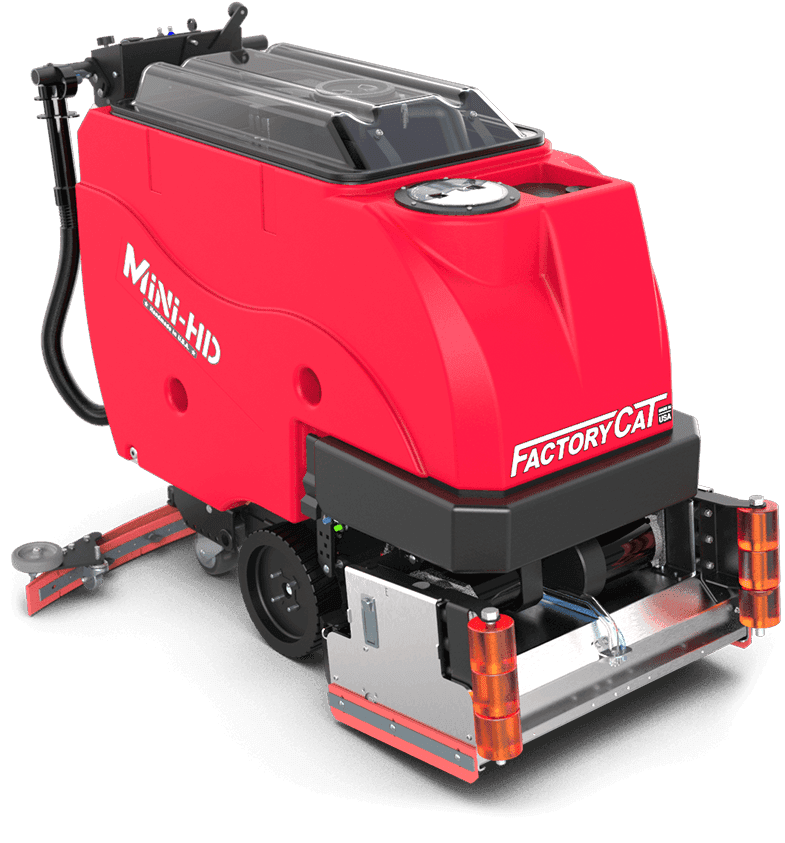
Mini-HD v2.1
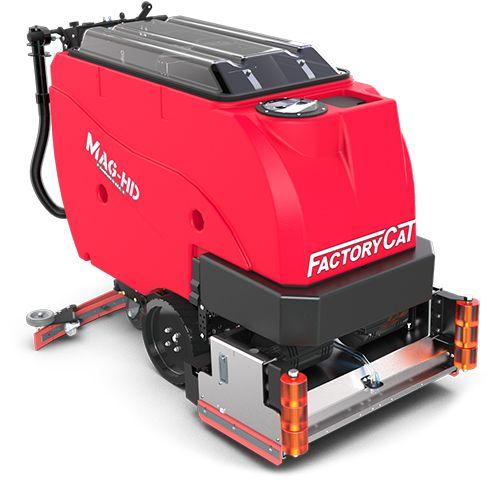
Mag-HD v2.2
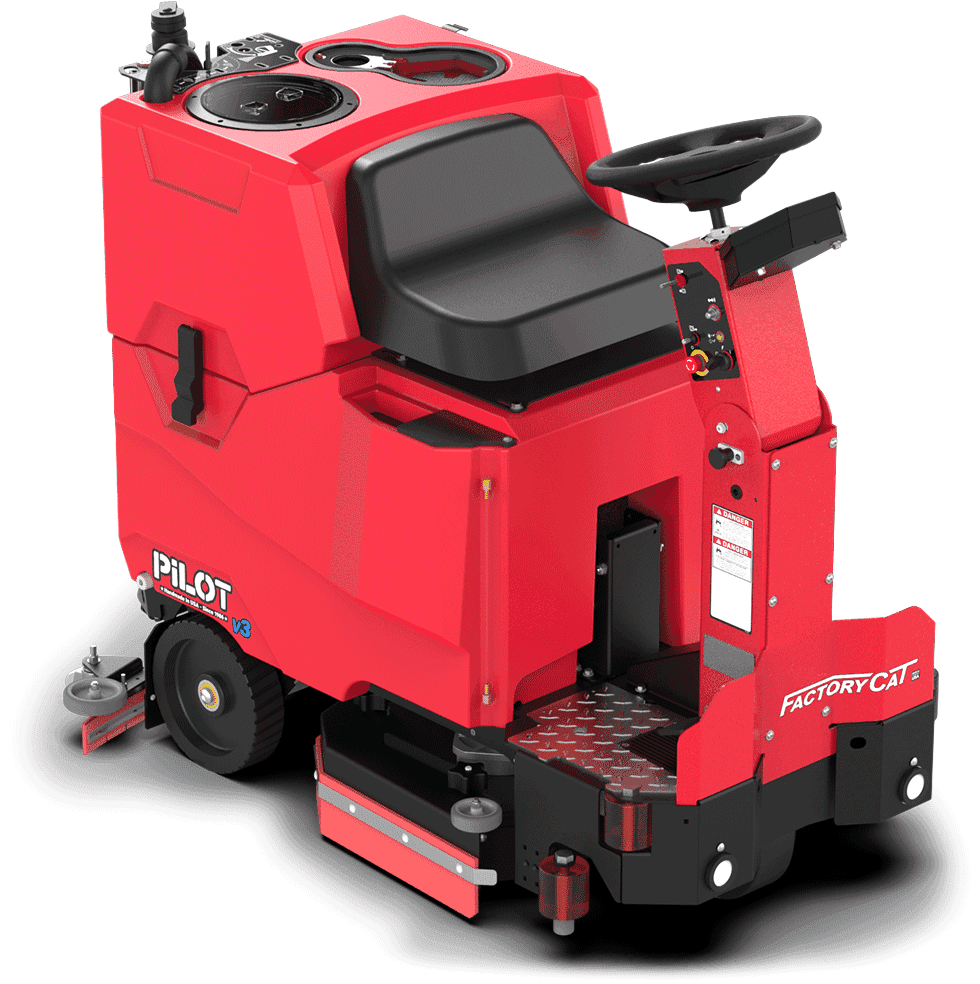
Pilot v3
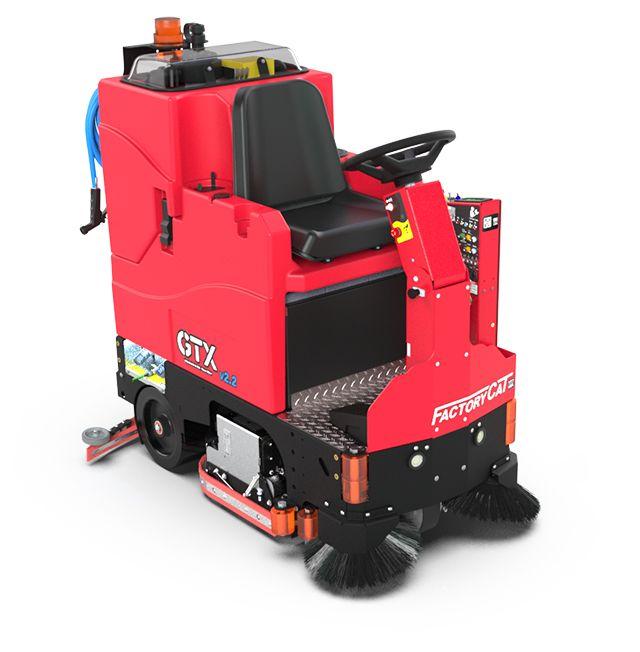
GTX v2.2
Related Articles
Frequently Asked Questions
Is a rider floor scrubber faster than a walk-behind?
Yes, in floor covered per hour, on FactoryCat's published figures. Even the smallest rider, the Pilot, covers up to 18,000 sq ft per hour in practical use, against up to 15,784 on the largest walk-behind, the Mag-HD. On a 50,000 sq ft floor, that is about 2.8 hours against 3.2.
Is a big walk-behind a better buy than a small rider?
It can be. The Mag-HD holds more solution than the Pilot (35 vs 22 gallons) and runs longer (up to 5 vs up to 4 hours). The Pilot covers more floor per hour, and its operator sits. Pick the Mag-HD if your team is happy to walk, and the Pilot if operator hours and effort matter more.
Can I get an orbital deck on a rider?
Yes, on the Pilot and GTX. The orbital deck, which some buyers call oscillating, is also offered on the MicroMini, Micro-HD, Mini-HD and Mag-HD walk-behinds. FactoryCat describes it as "ideal for deep scrubbing and chemical free stripping". The GTR and XR riders do not offer it.
What about a stand-on scrubber?
FactoryCat makes one stand-on, the Rebel, with a 20-inch disk deck. The operator rides standing, so it sits between the two formats. No tank size, run time or sq ft per hour is published for it. The walk-behind vs stand-on guide covers it in full.