Walk-behind vs stand-on floor scrubbers: is stand-on the middle ground?
Short answer
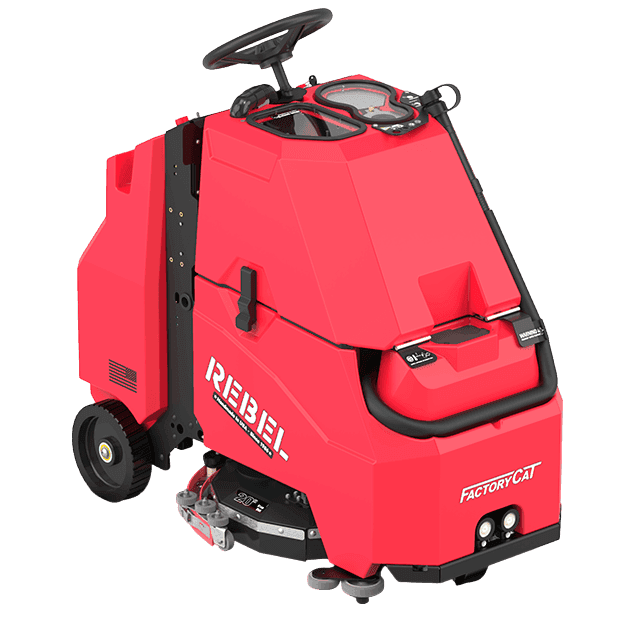
A stand-on scrubber is the middle ground: the operator rides standing, so it usually travels faster than a walk-behind and is quicker to step off than a seated rider. FactoryCat's stand-on, the Rebel, cleans a 20-inch path, the same as the 20-inch option on its smallest walk-behinds. Pick it for stop-and-go work in busy aisles, a walk-behind for small rooms, and a rider for big open floors.
What is a stand-on floor scrubber?
A stand-on scrubber is a riding machine with no seat. The operator stands on a platform and drives it. You do not walk behind it, and you do not sit on it.
FactoryCat makes one stand-on: the Rebel. It takes a 20-inch disk deck. It runs on WET or AGM batteries, and an onboard charger is offered. Its model page describes it as "highly maneuverable", with "oversized wheels and scrub motor".
No size, tank size, run time, weight or square feet per hour is published for the Rebel. Ask for those figures, or a demo on your own floor, before you buy.
What does a stand-on do better than a walk-behind?
It saves the operator's legs. A walk-behind moves at the pace of the person walking behind it. On a stand-on, the operator rides, so walking speed is no longer the limit. Over a long route, standing on a platform is also less tiring than walking the whole way.
Riding does not add width, though. The Rebel's 20-inch deck is the same width as the 20-inch disk option on the MicroMini and Micro-HD. So a stand-on adds riding, not width.
Path width is a big part of how much floor you cover. FactoryCat's walk-behinds clean up to 7,308 sq ft per hour (MicroMini) to up to 15,784 sq ft per hour (Mag-HD) in practical use, based on ISSA 2010 cleaning times. The Mag-HD cleans a disk path up to 34 inches wide. If your real problem is too many passes, a wider walk-behind may fix it.
What does a stand-on do better than a rider?
It is quick to get on and off. Many jobs are short: a spill, a dock door, a corridor between rooms. Stepping off a platform is quicker than climbing out of a seat. Standing also puts the operator's eyes high, which helps in busy aisles.
It is also more compact. With no seat, a stand-on is usually shorter than a rider, which helps in tight turns. The Rebel's own size is not published, so measure your tightest turn and ask before you buy.
But riders win on output. FactoryCat's riders clean up to 18,000 sq ft per hour (Pilot) to up to 29,374 sq ft per hour (XR) in practical use. Their solution tanks hold 22 to 65 gallons, and they run up to 4 to 5 hours.
Rider disk paths run from 26 to 45 inches, and only the riders offer a lithium battery option. On a big, open floor, a rider finishes sooner.
Who should buy a stand-on scrubber?
Pick a stand-on when one person handles many short jobs across a building in one shift. Pick it when a walk-behind is too slow, but a seated rider feels too big for your aisles.
Skip it if you need a cylindrical or orbital deck, a path wider than 20 inches, lithium batteries, or published run time and tank figures to plan a shift.
When is a walk-behind still the right call?
When the area is small. A walk-behind suits small rooms and one area at a time. It moves at walking pace, so it is easy to control close to people.
When you need an orbital deck. The Rebel takes a disk deck only. FactoryCat describes its orbital deck, also called oscillating, as "ideal for deep scrubbing and chemical free stripping". It is offered on six models, and four of them are walk-behinds: the MicroMini, Micro-HD, Mini-HD and Mag-HD.
When a big walk-behind is enough. The Mag-HD cleans up to 15,784 sq ft per hour in practical use, against the Pilot rider's up to 18,000 sq ft per hour. It also holds more solution than the Pilot (35 vs 22 gallons) and runs longer (up to 5 vs up to 4 hours). If your operators don't mind walking, it covers a lot of floor on one charge.
Do not assume a rider is always bigger. The Pilot rider is 54 by 27 inches. The Mag-HD walk-behind is 62 by 31 inches in its smallest build. These are published sizes, and they may not include the deck or squeegee. The Mag-HD's disk path goes up to 34 inches, so ask for the widest point before you check a doorway.
How do cost and labor compare across the three formats?
Cost of ownership is more than the price. It covers the machine, the labor hours to clean your floor, and the parts you replace, such as batteries, pads, brushes and squeegee blades. Square feet per hour is how you compare the labor part.
FactoryCat publishes no price for any machine, so the machine part of the sum has to come from your dealer. Ask for a quote on each format you are weighing, and ask what each quote includes.
The labor part you can work out yourself. Every FactoryCat rider covers more floor per hour than any FactoryCat walk-behind, so a rider needs the fewest operator hours. The Rebel is harder to place, because no rate is published for it. A wide walk-behind, such as the Mag-HD with its 34-inch disk deck, can need fewer hours than the 20-inch Rebel. Time a Rebel on your own floor to see the difference.
To check your own math, divide your floor area by the practical sq ft per hour in the table below. For example, a 50,000 sq ft floor takes about 3.2 hours with a Mag-HD, inside its run time of up to 5 hours. A Pilot rider takes about 2.8 hours. A MicroMini takes about 6.8 hours, more than twice its run time of up to 3 hours.
Side-by-Side Comparison
| Machine format | Walk-behind | Stand-on | Rider |
|---|---|---|---|
| FactoryCat models | MicroMini, Micro-HD, Mini-HD, Mag-HD | Rebel | Pilot, GTX, GTR, XR |
| Disk scrub path | 17"–34" | 20" | 26"–45" |
| Practical area rate | Up to 7,308–15,784 sq ft/hr | Not published | Up to 18,000–29,374 sq ft/hr |
| Solution tank | 10–35 gal | Not published | 22–65 gal |
| Published size (L×W) | 42×21" to 62×31" (Mag-HD smallest build) | Not published | 54×27" to 77×43" |
| Battery options | WET or AGM | WET or AGM | WET, AGM or lithium |
| Operator effort | Walks the whole route | Rides standing | Rides seated |
| Orbital deck offered | Yes, on all four | No | Yes, on the Pilot and GTX |
Related Machines
Rebel

Mag-HD v2.2

Pilot v3
Related Articles
Frequently Asked Questions
Is a stand-on floor scrubber faster than a walk-behind?
It usually travels faster, because the operator rides instead of walking. But the floor cleaned per hour also depends on path width. The Rebel cleans a 20-inch path, while the Mag-HD walk-behind cleans a path up to 34 inches wide and up to 15,784 sq ft per hour in practical use. No area rate is published for the Rebel, so time both on your own floor.
Is standing on a scrubber all shift tiring?
Standing is more tiring than sitting, but less tiring than walking the whole route. If one person cleans a large floor for a full shift, a seated rider is easier on them. For shorter runs with many stops, a stand-on is quicker to step on and off.
Can the Rebel strip floor finish without chemicals?
No. FactoryCat's chemical-free stripping claim is for its orbital deck, and the Rebel takes a disk deck only. The orbital deck is offered on the MicroMini, Micro-HD, Mini-HD, Mag-HD, Pilot and GTX.
What batteries does the Rebel use?
WET or AGM, and an onboard charger is offered. Lithium is listed only on FactoryCat's riders: the Pilot, GTX, GTR and XR.
Does FactoryCat make more than one stand-on scrubber?
No. The Rebel is FactoryCat's only stand-on scrubber. If it does not fit your job, compare a walk-behind and a rider using the table above.